How to Compare Cloud Service Providers in 2025 and Beyond
Comparing cloud service providers isn’t about picking the cheapest option. It’s about finding a strategic partner whose technology, pricing, and support align with your business goals. A clear, data-driven framework is the only way to make the right choice.
Building Your Cloud Evaluation Framework
Before comparing providers, establish your own evaluation framework. Without one, you’ll get lost in feature lists and marketing, leading to a decision that fails in the long run. A solid framework bases the choice on your business requirements, not just a spec sheet.
The core of this process is identifying and weighting what matters to your organization. A data science firm will prioritize raw compute power, while a healthcare company will focus on specific compliance certifications.
The Seven Pillars of Cloud Evaluation
A robust framework is built on seven core pillars. Scoring potential providers against each creates an objective, quantifiable method for your final decision.
- Core Performance and Services: Evaluate the fundamentals: compute, storage, and networking power. Does the provider excel in the specific services you need, like IaaS, PaaS, or serverless functions?
- Specialized Capabilities: Look ahead. Analyze advanced offerings like AI/ML toolsets, data analytics platforms (e.g., Google BigQuery), and managed Kubernetes services. These tools keep your tech stack competitive.
- Pricing and Total Cost of Ownership (TCO): Look beyond the sticker price. Analyze pricing models—pay-as-you-go, reserved instances—and watch for hidden costs like data egress fees. To control financials, implement proven cloud cost optimization strategies.
- Security and Compliance: This is non-negotiable. Confirm the provider meets your industry standards, whether HIPAA, GDPR, or others. Scrutinize their security posture, identity management, and data encryption policies.
- Enterprise Support and SLAs: What happens when something breaks? Understand what level of support is included and what costs extra. Examine Service Level Agreements (SLAs) for uptime guarantees and response times, as they directly impact operational stability.
- Migration and Interoperability: Moving existing workloads can be a major hurdle. Assess the provider’s migration tools, partner ecosystem, and support for multi-cloud or hybrid setups.
- Innovation and Ecosystem: A provider’s R&D investment indicates their long-term value. A strong partner network and marketplace provide access to critical third-party tools and expertise.
A common mistake is focusing on compute pricing while underestimating migration and retraining costs. Your TCO analysis must include the human capital investment needed to operate the new environment effectively.
Using these criteria, you can compare cloud service providers on a level playing field. The table below summarizes what to focus on.
Key Decision Criteria for Cloud Provider Selection
This table breaks down the essential factors. Use it as a starting point for your own evaluation scorecard.
| Evaluation Pillar | What to Assess | Why It Matters |
|---|---|---|
| Performance | Compute instances, storage speed, network latency | Directly impacts application responsiveness and user experience. |
| Pricing & TCO | On-demand rates, reserved discounts, egress fees | Determines the long-term financial viability and return on investment. |
| Security | Compliance certifications, encryption, access controls | Protects sensitive data and ensures regulatory adherence. |
| Support | SLA guarantees, response times, available expertise | Guarantees business continuity and provides help during critical issues. |
Each pillar carries different weight depending on your needs, but evaluating all of them is the first step toward a confident, informed decision.
Comparing the Big Three: AWS, Azure, and Google Cloud
When you compare cloud service providers, the conversation centers on the “Big Three”: Amazon Web Services (AWS), Microsoft Azure, and Google Cloud Platform (GCP). While they offer similar core services, their strategies and ideal use cases differ significantly. Choosing the right one means looking past a feature checklist to understand each platform’s vision.
This isn’t about finding the single “best” provider. It’s about finding the best fit for your technical needs, IT ecosystem, and long-term business goals. A decision that works for a cloud-native startup could be a mistake for a large enterprise with a complex hybrid environment.
Let’s start with a high-level view of each provider’s market position.
Cloud Provider At-a-Glance Market Position and Core Strengths
| Provider | Market Position | Primary Strengths & Ideal Use Cases | Key Differentiator |
|---|---|---|---|
| AWS | The established market leader with the largest share and longest track record. | Vast service portfolio, mature ecosystem, enterprise reliability. Ideal for nearly any workload, from simple websites to massive-scale deployments. | The breadth and depth of its service catalog—if you can imagine a use case, AWS has a tool for it. |
| Azure | The strong second-place contender, dominant in enterprise and hybrid cloud. | Seamless integration with Microsoft’s software stack (Office 365, Windows Server). Best for companies invested in the Microsoft ecosystem or those with complex hybrid cloud needs. | Its “meet you where you are” hybrid cloud strategy, powered by tools like Azure Arc. |
| GCP | A strong third with deep expertise in specialized, high-growth areas. | Best-in-class data analytics, machine learning, and container orchestration (Kubernetes). The go-to for data-driven, cloud-native companies focused on innovation. | Elite engineering and open-source leadership, particularly with BigQuery and Google Kubernetes Engine. |
This table provides a high-level overview, but the right decision depends on details that align with your specific situation.
AWS: The Market Leader and Incumbent
As the first major player, AWS is the market incumbent, with the most extensive service portfolio and the largest global footprint. Its greatest strength is its maturity. For over a decade, the platform has been battle-tested at scale, making it the default choice for enterprises that value stability, a massive third-party ecosystem, and an unparalleled number of service options.
If you need a solution for virtually any workload, AWS has a specialized service ready. While this choice is an advantage, it can also lead to complexity, especially in managing costs and selecting the right services without strong governance.
AWS’s strategy is to be the one-stop shop for cloud infrastructure. Its massive service catalog and mature partner network create a powerful draw for any organization seeking proven, scalable solutions.
Azure: The Enterprise and Hybrid Cloud Champion
Microsoft Azure has secured its strong market position by leveraging its enterprise strengths. Its primary differentiator is seamless integration with the existing Microsoft software stack, including Office 35, Active Directory, and Windows Server. For businesses already using Microsoft products, Azure is a natural extension of their current environment, simplifying the cloud transition.
This integration is most evident in its hybrid cloud strategy. Services like Azure Arc and Azure Stack are designed for organizations managing resources across on-premise data centers and the public cloud. This makes Azure a compelling choice for companies in regulated industries or those modernizing legacy applications incrementally.
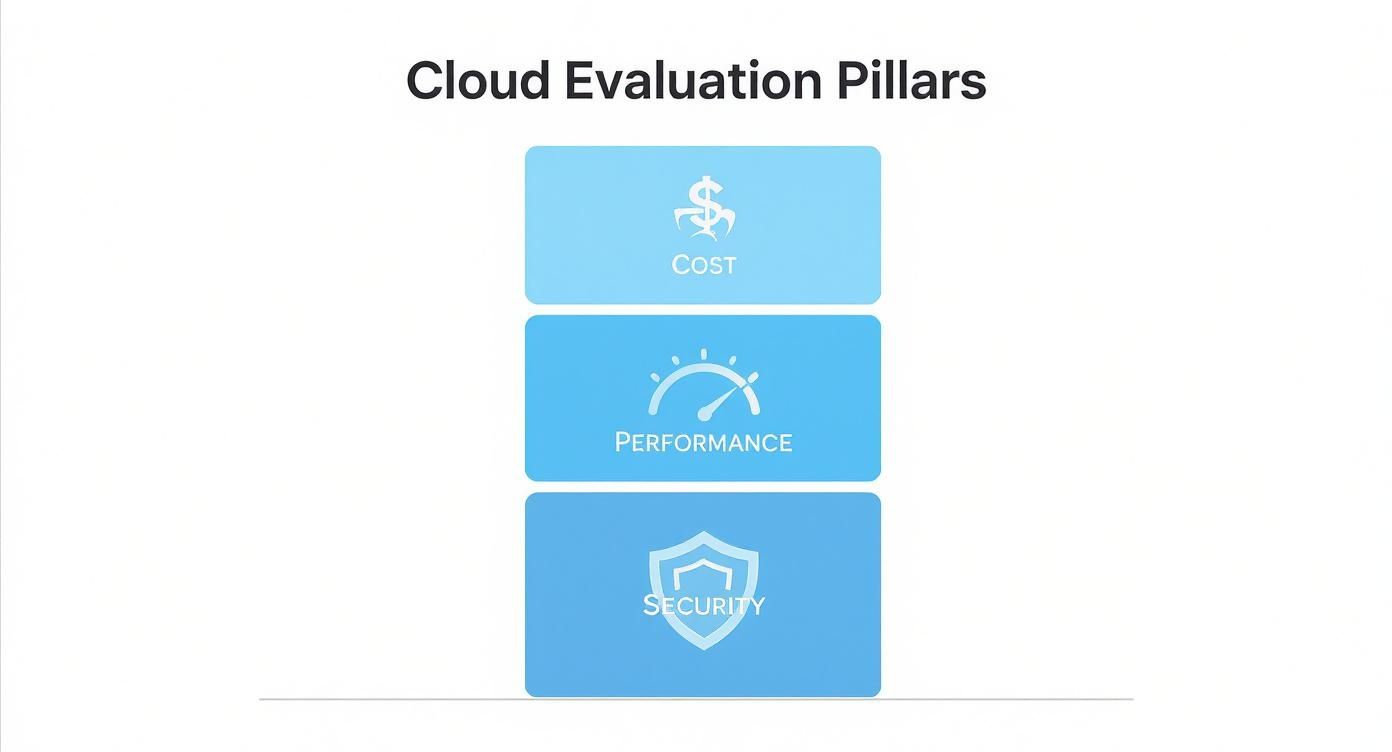
A solid evaluation must balance financial impact (cost), technical capabilities (performance), and risk management (security). It’s a constant trade-off.
GCP: The Innovator in Data and Cloud-Native Tech
While third in market share, Google Cloud Platform (GCP) is a leader in data analytics, machine learning (AI/ML), and container orchestration. GCP is built on the same infrastructure that powers Google Search and YouTube, offering world-class performance in networking and data processing. Its strategy is focused on providing best-in-class tools for innovative, cloud-native businesses.
GCP’s standout services include:
- BigQuery: A serverless, highly scalable data warehouse for running fast SQL queries over massive datasets.
- AI Platform: A suite of advanced machine learning services for building and deploying intelligent applications.
- Google Kubernetes Engine (GKE): Widely regarded as the leading managed Kubernetes service, developed by the technology’s creators.
This focus makes GCP the platform of choice for companies whose competitive advantage is built on data science and modern application development. Organizations prioritizing innovation and developer experience often find GCP’s streamlined toolset ideal.
AWS: The Battle-Tested Market Leader
When you compare cloud service providers, Amazon Web Services (AWS) is typically the first name mentioned. As the original pioneer, its reputation is built on an extensive portfolio of services and proven, large-scale reliability. For any organization where stability and a mature toolset are critical, AWS is the established benchmark.
The core advantage of AWS is its scale. With over 200 services, it offers a specialized tool for nearly any workload. This allows engineers to find a purpose-built service, which can significantly accelerate development.

Unmatched Market Dominance and Ecosystem
The data is clear. As of Q2 2025, AWS holds a commanding 30% share of the global cloud infrastructure market, with roughly $30.9 billion in quarterly revenue. This translates into a massive, mature ecosystem of third-party tools, integrations, and certified consulting partners. Support is always available. More market share data can be found at SlickFinch.com.
This maturity also means the documentation and community support are unparalleled. If you encounter a problem, it’s likely someone has already solved it and documented the solution. This shortens the learning curve and empowers teams to solve problems independently.
The biggest advantage of AWS is its battle-tested infrastructure. Enterprises trust it because it has been proven to work at immense scale for over a decade, handling critical workloads for the world’s largest companies. This track record provides a level of assurance that is difficult for other providers to match.
Key Technical Strengths
Several technical areas highlight why AWS maintains its top position.
- Compute Versatility: From Amazon EC2 instances to serverless functions with AWS Lambda, the variety of compute options is extensive, including specialized instances for machine learning, high-performance computing (HPC), and memory-intensive applications.
- Storage Scalability: Amazon S3 is the industry standard for object storage due to its durability, scale, and performance. Combined with services like EBS for block storage and EFS for file systems, AWS provides a solid foundation for any data strategy.
- Global Reach: With data centers in dozens of regions worldwide, AWS allows you to place applications close to users, reducing latency and supporting disaster recovery and data residency requirements.
Primary Considerations and Challenges
The power of AWS comes with trade-offs. The most common challenge is pricing complexity. With numerous services, each with its own billing metrics, forecasting and controlling costs requires a dedicated governance plan.
This complexity can lead to unexpected costs if resources aren’t continuously monitored and optimized. Understanding AWS migration best practices is crucial to avoid common financial traps.
Another issue is service overload. While having a tool for every job is beneficial, it can create a steep learning curve. Teams must identify the right service for their needs to avoid suboptimal or overly expensive solutions. This often requires careful planning and expert guidance.
A Closer Look at Azure for Enterprise and Hybrid Setups
Microsoft Azure holds a commanding position in the cloud market by serving the enterprise. Its foundation is a deep understanding of corporate IT, especially for companies within the Microsoft ecosystem. This built-in familiarity reduces the learning curve and integration challenges that can derail cloud projects.
By Q2 2025, Microsoft Azure secured its spot as the second-largest cloud provider, holding 20% of the global market. Its 18% year-over-year growth was largely driven by its dominance in hybrid cloud solutions. You can find more statistics in the global cloud market share report on Tekrevol.com.
Mastering the Hybrid Cloud and Enterprise Integration
Azure’s key advantage is its handling of the hybrid environment. Unlike competitors where hybrid feels like an add-on, it’s integral to Azure’s platform DNA. This is where services like Azure Arc and Azure Stack excel.
- Azure Arc provides a single management plane for resources, regardless of their location—on-premise, in Azure, or on other clouds like AWS or GCP.
- Azure Stack brings a portion of Azure into your data center, enabling consistent application development and deployment across cloud and on-premise hardware.
This “meet you where you are” approach is critical for businesses that cannot immediately move entirely to the public cloud. It provides a practical, gradual path to modernization without requiring them to discard existing infrastructure investments.
The cloud journey is often a slow modernization, not a disruptive “lift-and-shift.” Azure’s hybrid model acts as a bridge, allowing companies to extend their current infrastructure into the cloud rather than forcing a complete rebuild.
Azure’s native integration with tools like Office 365, Microsoft Teams, and Active Directory is unmatched. For companies already using Active Directory for identity management, connecting to Azure is a logical and secure step. This tightly woven ecosystem simplifies management, strengthens security, and creates a consistent user experience.
Built for Compliance and Security in Regulated Fields
Given its enterprise focus, Azure has invested heavily in security and compliance. The platform holds an extensive portfolio of certifications, meeting the requirements of highly regulated industries like finance, healthcare, and government. For organizations where compliance is non-negotiable, Azure is often the default choice.
Services like Azure Sentinel (a cloud-native SIEM) and Azure Security Center offer sophisticated threat protection for both cloud and on-premise workloads. In a hybrid environment where security visibility can become fragmented, this unified view is invaluable.
However, this enterprise-grade power can be a drawback. For a small, cloud-native startup with no Microsoft footprint, the platform might feel overly complex. While Azure is versatile, its core value is most apparent for established organizations seeking a structured, secure, and integrated way to extend and modernize their existing infrastructure.
Evaluating Google Cloud for Data Analytics and AI
While not matching the market share of AWS or Azure, Google Cloud Platform (GCP) has established itself as a specialist for data-intensive and cloud-native workloads. Google leverages its engineering prowess, focusing on world-class data analytics, AI, and container orchestration. This makes GCP a compelling option for companies whose competitive edge is built on innovation.
GCP’s philosophy is less about a sprawling service catalog and more about an integrated toolkit for modern developers, evident in its work with Kubernetes and scalable data platforms.

Differentiators in Data and Machine Learning
GCP excels at processing and analyzing enormous datasets at high speed. BigQuery, its serverless data warehouse, allows teams to run complex SQL queries across petabytes of data and receive results in seconds. For businesses dependent on real-time insights, this is a game-changer.
The same applies to its AI and machine learning tools, particularly the Vertex AI platform. It simplifies the entire machine learning workflow, from building and training to deploying and managing models. For embedding intelligence into applications, GCP offers a distinct advantage.
The real value of GCP comes from its engineering pedigree. It runs on the same global infrastructure that powers Google Search and YouTube, giving it incredible performance for data-intensive jobs and a network that is tough for competitors to beat.
Kubernetes and Cloud-Native Leadership
Google invented and open-sourced Kubernetes, so it’s no surprise that Google Kubernetes Engine (GKE) is widely considered the most mature and robust managed Kubernetes service available. With advanced cluster management, efficient autoscaling, and top-tier security, it provides a superior developer experience for building scalable applications.
This leadership in the cloud-native space makes GCP the default choice for organizations committed to modern, microservices-based architectures. While other clouds offer managed Kubernetes, GKE often sets the standard for features and operational stability.
Market Position and Pricing Philosophy
Google Cloud holds third place in the cloud market with a 13% share as of Q2 2025. Its growth, fueled by strengths in AI and advanced analytics, demonstrates the success of its strategy targeting data-driven, high-growth industries. More details are available in this analysis of the global cloud infrastructure market on Cargoson.com.
GCP’s pricing is also a key differentiator. It was an early adopter of per-second billing and offers automatic Sustained Use Discounts, which reduce costs for consistently running workloads without requiring complex upfront commitments. This flexible model can lead to significant savings, a crucial detail when you compare cloud service providers on total cost.
How to Make Your Final Cloud Provider Decision
You’ve reviewed the major players. Now it’s time to move from theoretical comparison to a practical, evidence-based decision for your business. This involves validating assumptions with real-world tests to choose a long-term partner that fits your technical and financial roadmap.
First, return to your scoring framework. Weight each category—from core performance to enterprise support—based on your priorities. A startup focused on speed to market will prioritize AI services and serverless functions, while a large enterprise might be more concerned with hybrid capabilities and compliance.
Run a Real-World Proof of Concept
Once you’ve narrowed it down to two contenders, conduct a Proof of Concept (PoC). A PoC is a small-scale, realistic test of your most important workload on each platform. This should be a true representation of a production workload, not a simple tutorial.
For example, an e-commerce company could test its product recommendation engine on both clouds, measuring:
- Performance: How quickly does the ML model process data and generate results under stress?
- Operational Ease: How difficult is it for engineers to deploy, monitor, and scale the application using each provider’s native tools?
- Cost Efficiency: What was the actual cost to run the workload for a week? Look at the final bill, not the advertised instance price.
This hands-on experience provides ground-truth data that a spec sheet cannot, revealing hidden issues and confirming whether a provider’s strengths match your team’s needs.
Build a Detailed Total Cost of Ownership Model
With PoC data, you can build a realistic Total Cost of Ownership (TCO) model. Now you can move beyond obvious compute and storage costs to analyze the expenses that often inflate budgets.
The most common TCO mistake is underestimating “other” costs. Data egress fees, premium support plans, and third-party marketplace tools can easily add 20-30% to your monthly bill if you don’t plan for them.
Your analysis must include data transfer fees between regions, the cost of the necessary support plan, and licensing fees for marketplace software. Also, factor in the “soft” cost of retraining your team. A structured guide like this vendor due diligence checklist can help ensure you don’t miss anything.
Look at Your Team and Negotiate Your Deal
Finally, assess your team’s current skills. If your engineers are proficient with Kubernetes, a provider with a mature managed Kubernetes service will ensure a smoother transition. If not, budget for training or engage a cloud consulting partner to fill the gaps.
Armed with PoC results and a solid TCO, you are in a strong position to negotiate an Enterprise Agreement (EA). Use your data to push for better discounts on reserved instances, committed use, or support plans. This final step ensures you’re not just selecting a provider but securing a partnership that delivers true value.
Got Questions About Comparing Cloud Providers? We Have Answers.
Comparing cloud providers can be overwhelming. Let’s address some of the most common questions and challenges.
Vendor lock-in is a real concern. It occurs when moving off a platform becomes technically and financially prohibitive, often due to dependency on proprietary services like AWS Lambda or Google BigQuery.
The best defense is to plan for an exit from the start. Prioritize providers that support open-source technologies like Kubernetes and design your applications for portability. This provides leverage and keeps your options open.
Getting Real About Multi-Cloud and Cost Projections
A multi-cloud strategy—using services from different providers—can offer the best of all worlds. You might run core compute on AWS while using GCP for its machine learning tools, boosting resilience and accessing specialized features.
However, this approach adds complexity. Managing security, billing, and operations across multiple clouds is challenging. A successful multi-cloud setup often requires a unified management platform or an experienced consulting partner.
The biggest mistake in cloud cost forecasting is focusing on advertised server and storage prices. Real-world total cost is always higher due to data egress fees, premium support, and essential add-ons like load balancers and monitoring. These can easily inflate your final bill by 20-30%.
To accurately predict long-term costs:
- Run a Proof of Concept (PoC). Deploy a core workload on your top two choices to see their actual performance and resource consumption.
- Model your data transfer. Data egress—moving data out of the cloud—is a significant cost. Estimate how much data you will transfer out.
- Price in the right support plan. Factor in the cost of the support plan your team will actually need, not the free tier.
Following these steps transforms your cost analysis from a rough estimate into a solid financial projection, creating a sustainable cloud strategy.
Choosing the right platform is only half the battle; finding the right experts to guide you is just as crucial. CloudConsultingFirms.com provides an independent, data-driven directory to help you connect with the perfect cloud consulting partner for AWS, Azure, or Google Cloud. Make sure your project is a success from day one. Start your partner search on CloudConsultingFirms.com.