The Engineering Leader's Guide to FinOps Consulting
Unmanaged cloud spend is a tax on innovation. For engineering leaders, an ever-growing bill from AWS, Azure, or GCP directly consumes the budget for R&D, new features, and hiring top talent. FinOps consulting addresses this by embedding financial accountability into the engineering lifecycle, transforming cloud costs from a reactive problem into a predictable, value-driven investment.
This is how you stop reacting to cost overruns and start funding your roadmap.
Your Cloud Bill Is an Innovation Problem
When engineering teams operate without visibility into the cost of their architectural choices, waste is not a risk; it’s a certainty. This inefficiency directly drains the budget needed for innovation.
FinOps consulting bridges the gap between engineering and finance, shifting the organization from reactive cost-cutting to a proactive operating model focused on unit economics and value, with proven cloud cost optimization strategies at its core. A qualified partner doesn’t just deliver a savings report; they embed a sustainable culture of cost-awareness, building the capability within your teams.
This solves three core problems for engineering leaders:
- It eliminates blind spots. You gain real-time visibility into which services, teams, and projects drive spend.
- It aligns incentives. Engineering objectives become tied to financial outcomes, encouraging cost-efficient design without throttling speed.
- It creates predictable budgets. Volatile cloud bills transform into a forecastable expense, enabling reliable long-term planning.
The FinOps Foundation defines FinOps as an operational framework and cultural practice built on collaboration between engineering, finance, and business teams. It is most useful when it changes how those teams make engineering and procurement decisions, not when it produces another billing dashboard. Evaluate a prospective partner’s operating model, decision rights, and evidence of implemented changes before treating it as a cost-management solution.
FinOps isn’t about saving money—it’s about making money. By treating cost as a first-class metric alongside performance and reliability, you empower engineers to make smarter, more profitable architectural decisions.
The conversation shifts from “How do we cut the cloud bill?” to “How do we maximize the business value of every dollar spent in the cloud?” Wasted spend is recaptured and reinvested into innovation.
What a FinOps Consulting Engagement Delivers
A FinOps consulting engagement is not a one-off audit. It’s a capability transfer. The goal is to build your team’s muscle memory for making cost-aware decisions, making the partner’s hands-on involvement obsolete over time.
The engagement follows the three phases of the FinOps lifecycle: Inform, Optimize, and Operate.
Phase 1: Gaining Total Visibility (The ‘Inform’ Stage)
You cannot manage what you do not measure. This initial phase establishes a single source of truth for all cloud spending. A consultant acts as a forensic accountant, transforming raw billing data into actionable intelligence.
- Objective: Achieve 100% visibility into cloud spend, allocated accurately to the specific team, project, or feature.
- Deliverables: Custom-built dashboards and cost allocation reports that map spend directly to business units and cost centers.
- Outcome: Opaque, multi-million-dollar cloud bills are demystified. Engineering and finance leaders see exactly who is spending what and why, ending the blame game.
Phase 2: Driving Real Efficiency (The ‘Optimize’ Stage)
With clear visibility established, the focus shifts to optimization. This phase delivers tangible savings by eliminating waste and ensuring you pay the lowest possible price for necessary resources through actionable optimization strategies. This involves two parallel tracks.
First is usage optimization: identifying and terminating idle databases, over-provisioned servers, and unattached storage volumes. The second is rate optimization: maximizing commitment-based discounts like AWS Savings Plans, Azure Reservations, and GCP Committed Use Discounts. A seasoned consultant blends both to maximize savings.
This is where FinOps translates engineering decisions into financial outcomes.
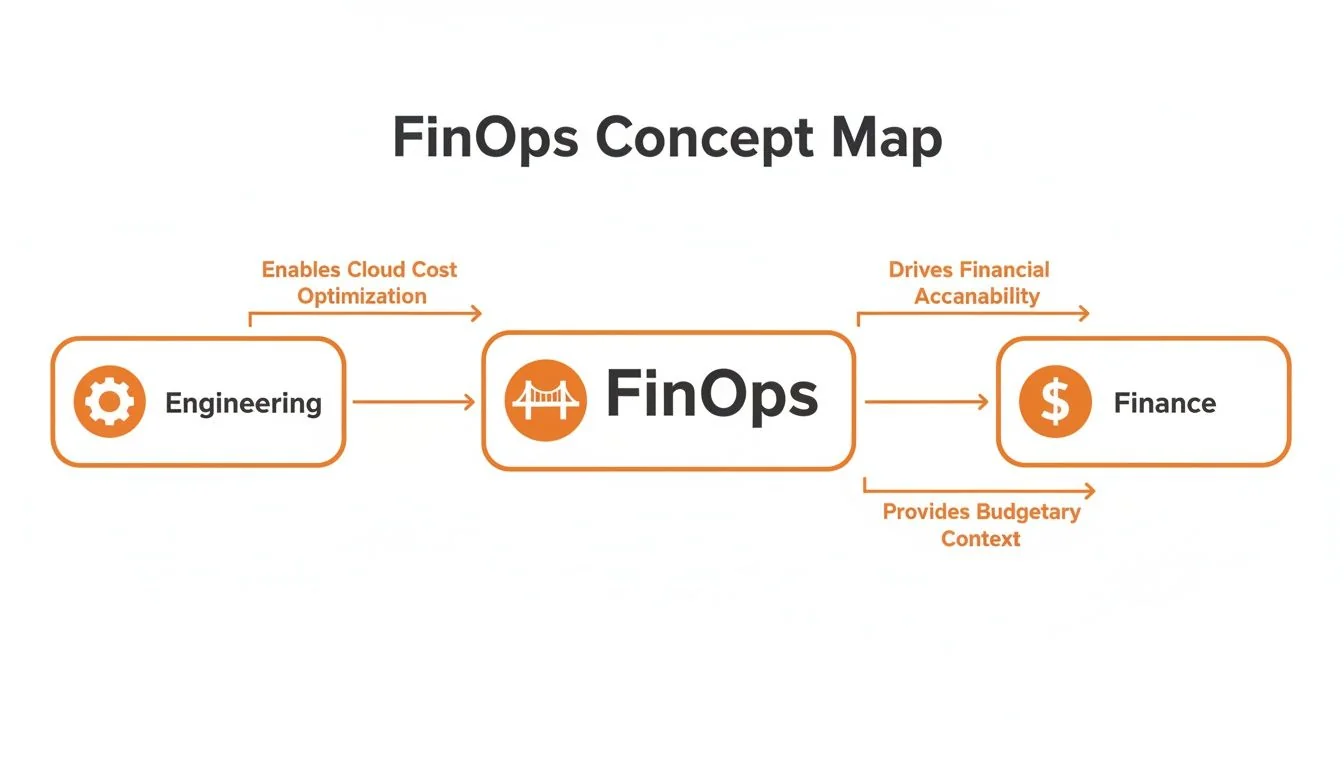
FinOps creates a shared language and accountability model between technical and financial teams.
Phase 3: Making It Stick (The ‘Operate’ Stage)
This final phase operationalizes FinOps as a permanent business discipline. The goal is to bake cost-awareness into the engineering culture, making efficiency automated and continuous.
Here, the consultant transitions from doing the work for you to empowering your teams to do it themselves. The focus shifts to implementing automated guardrails—such as budget alerts and scripts that terminate non-compliant resources—and establishing a collaborative rhythm between finance and engineering.
Embedding this discipline is critical. The market for FinOps services is growing at a 13.0% CAGR because over 70% of organizations lack the internal skills to implement FinOps effectively. You can explore the research on the growing FinOps skills gap to understand the scale of this challenge. A successful engagement closes that gap, building the capability within your organization for sustained value.
Building the Business Case for FinOps Consulting
Securing budget for a FinOps consultant requires a business case demonstrating a clear return on investment. The objective is to frame the engagement not as a cost, but as a self-funding initiative.
Most organizations realize 15-30% in cloud cost savings within the first six months. These are the immediate wins from eliminating obvious waste that has been silently draining the budget.
Quantifying the Return on Investment
The core of your business case is direct, quantifiable savings. An experienced FinOps partner targets these areas first to stop financial leakage.
- Zombie Asset Elimination: These are forgotten resources—unattached storage volumes, idle RDS instances, unassociated Elastic IPs—that accrue charges. A consultant uses automated scripts to identify and terminate them for immediate savings.
- Rightsizing Overprovisioned Resources: Engineers often provision for peak load, leaving most resources underutilized. By analyzing actual usage data against performance metrics, a consultant can safely downsize instances without impacting performance, often cutting compute costs by 40-60% on targeted workloads.
Beyond direct cost-cutting, the engagement improves budget forecast accuracy and reduces friction between finance and engineering.
Frame the consulting fee as a self-funding investment. For an organization spending $2M annually on cloud, a 20% reduction unlocks $400,000. That capital can be reallocated to product development, strategic hires, or other innovation initiatives.
Presenting both the immediate savings and the long-term cultural shift makes a powerful case. You are proposing an investment in a new operating model that maximizes the business value of every cloud dollar.
How to Select the Right FinOps Consulting Partner

Selecting the right partner is the most critical decision in this process. The wrong partner creates dependency and delivers a one-time savings report. The right partner makes themselves obsolete by empowering your team.
Your vetting process must focus on technical depth, cultural change methodology, and business model alignment. A true FinOps consultancy is a hybrid team of certified cloud architects and finance professionals who can discuss architectural refactoring and amortization with equal fluency.
Verify True Technical and Cultural Expertise
A partner’s value lies in its ability to drive organizational change, not just operate a software tool. Across the 50 cloud consulting firms we profile, the useful test is whether a prospective partner can show how it will change engineering decisions around cost, rather than only analyze billing data.
A partner who only talks about Savings Plans and Reserved Instances is solving yesterday’s problem. A great FinOps consulting practice identifies architectural waste and empowers your engineers to build more cost-efficiently from the start.
Demand proof. Do their case studies show specific “before and after” examples of architectural changes that reduced consumption, or do they only highlight savings from commitment purchases?
Verify credentials. Are their consultants FinOps Certified Practitioners? This is table stakes. The real differentiator is deep, platform-specific certifications like AWS Certified Solutions Architect or Azure Solutions Architect Expert. This combination is non-negotiable. For a deeper dive on vetting suppliers, use our complete vendor due diligence checklist.
Use a structured checklist to compare partners on identical criteria, moving beyond a gut feeling to a data-backed decision.
FinOps Partner Evaluation Checklist
| Evaluation Criterion | What to Look For | Red Flags to Avoid |
|---|---|---|
| Team Composition | A blend of Certified Cloud Architects (AWS, Azure, GCP) and FinOps Certified Practitioners. | Teams heavy on finance/analyst roles with little engineering depth. |
| Technical Approach | Focus on architectural optimization, waste reduction, and building cost-aware engineering practices. | An over-reliance on simple rate optimization (e.g., Savings Plans, RIs) as the primary strategy. |
| Case Studies | Detailed examples of architectural changes and cultural shifts that led to sustainable savings. | Vague success stories focused only on a one-time percentage saved without context. |
| Tooling Philosophy | Preference for native cloud tools (AWS Cost Explorer, Azure Cost Management) and open industry standards. | Pushing a proprietary, black-box software tool that creates vendor lock-in. |
| Pricing Model | Flexible models (gain-share, hybrid) that align the partner’s success with your actual savings. | Rigid, long-term retainers with no clear performance incentives or exit clauses. |
Using this framework provides a clear, quantitative basis for comparing firms and identifying the one best equipped to deliver long-term value.
Aligning on Pricing Models and Outcomes
A firm’s pricing model reveals its incentives. While a fixed-fee project offers budget predictability, it does not guarantee optimal results. A gain-share model, where the consultant’s fee is a percentage of the savings they deliver, directly aligns their success with yours.
The most common pricing structures are:
- Fixed-Fee Project: Best for a tightly scoped engagement, like an initial cloud spend assessment or audit.
- Gain-Share Model: Excellent for ongoing optimization work. It motivates the partner to find deep, recurring savings, not just the low-hanging fruit. Typical rates are 20-30% of validated savings.
- Monthly Retainer: Works well for continuous governance and support after the initial heavy lifting of optimization is complete.
A hybrid approach is often most effective. An engagement might begin with a fixed fee for the “Inform” phase, then shift to a gain-share model for the “Optimize” and “Operate” phases once value is proven.
Be wary of any partner that mandates the use of their proprietary software. The best firms teach you to master your cloud provider’s native tools and open-source alternatives. This ensures you own the process, the data, and the skills long after the engagement ends.
Avoiding Common FinOps Engagement Pitfalls
A failed FinOps engagement does more than waste budget; it can create lasting distrust between teams and reinforce the belief that cloud costs are uncontrollable. Spotting red flags early is essential.
The Rate Optimization Trap
Many consultants with shallow expertise focus almost exclusively on rate optimization. They purchase Savings Plans or Reserved Instances and declare victory. This is a necessary step but addresses only half the problem, ignoring the more significant issue of architectural waste—over-provisioned databases, idle resources, and inefficient code that drive excess consumption.
This is equivalent to getting a better rate on your electricity while leaving the lights on in an empty building 24/7.
Critical Red Flag: A potential partner whose case studies only boast savings from commitment discounts. If they cannot provide concrete evidence of reducing resource consumption through architectural improvements, they are offering a superficial fix. Real FinOps addresses both what you pay and what you use.
Spotting Dependency Traps and Misaligned Incentives
Another major pitfall is the partner who funnels all data through their proprietary, “black box” software. While the dashboards may appear slick, this model is designed for vendor lock-in. Once the contract ends, you lose access to your historical data and the visibility you paid to create.
A credible consultant empowers your team using the tools you already have, like AWS Cost Explorer or Azure Cost Management. They teach you how to master your own data and build skills that persist long after the engagement.
Finally, reject any engagement that lacks joint sponsorship from both engineering and finance leadership. Recommendations developed in a finance-only silo will be dead on arrival with engineering. Without technical buy-in and cultural alignment, cost-saving initiatives are either technically infeasible or culturally rejected, rendering the effort useless.
Ask these direct questions during your evaluation:
- How do you measure success beyond rate optimization? Show us specific examples.
- Which tools will you use, and will we retain full ownership of and access to all data and dashboards created?
- Describe your process for facilitating collaboration between our finance and engineering teams.
A partner who struggles with these questions is not equipped to build a durable FinOps practice.
Your Action Plan for Launching a FinOps Practice
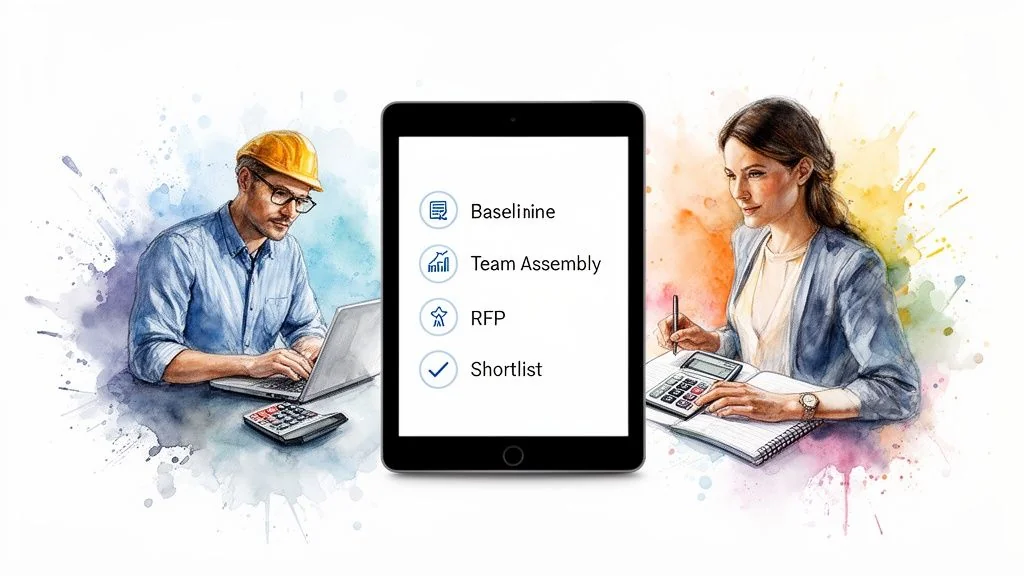
Progress requires action. The goal is not just to find one-off savings but to build a sustainable, cost-aware culture that reclaims capital for innovation.
This four-step plan moves you from analysis to action.
Step 1: Get a Baseline on Your Spend
You cannot fix what you cannot see. Before contacting any partner, establish a clear baseline. Use your native cloud tools—AWS Cost Explorer or Azure Cost Management—to identify your top three cost-driving services.
Is it compute? Data transfer? Managed databases? Identifying these provides an immediate focus for any FinOps engagement.
Step 2: Assemble Your “Tiger Team”
FinOps is a team sport. A siloed effort from a single department will fail. From day one, assemble a cross-functional “tiger team” to champion the initiative.
This team must include:
- An Engineering Lead: To validate technical solutions and drive adoption of new architectural patterns.
- A Finance Partner: To translate cloud spend into P&L impact and track ROI.
- A Product Manager: To provide business context and help prioritize which features justify their cloud footprint.
This group becomes the central nervous system for your FinOps practice, ensuring technical feasibility aligns with financial responsibility.
Step 3: Draft a Targeted RFP
With a baseline and a team, you are ready to write a request for proposal (RFP). Do not use a generic template. Craft a targeted request that addresses your specific pain points identified in Step 1.
Use the RFP to challenge potential partners. Ask them directly how they would approach cost reduction for your specific high-spend services. Demand case studies that reflect your cloud platform, industry, and scale. This will separate the true strategists from the marketing mouthpieces.
Step 4: Shortlist and Start the Conversation
With RFP responses in hand, narrow the list to 3-4 partners that align with your platform (AWS, Azure, or GCP), budget, and culture. The goal is to move from analysis to direct engagement.
Begin discussions with these shortlisted firms. This is where you will find the right fit and formally launch your FinOps consulting journey.
Common Questions About FinOps Consulting
Engineering leaders evaluating FinOps consulting often have the same critical questions. Here are the direct answers.
Is FinOps as a Service Really Better Than Doing It Ourselves?
A DIY approach typically fails due to a lack of specialized talent and the distraction of tool-building. True FinOps experts—a hybrid of senior cloud architect and financial analyst—are exceptionally rare and difficult to hire.
Building a proprietary FinOps tool distracts from your core product mission. A FinOps consulting partner arrives with a proven methodology, an experienced team, and battle-tested automation, delivering insights in weeks, not quarters. It accelerates time-to-value.
What’s the Real Difference Between FinOps and Traditional Cost Management?
Traditional cost management is reactive. The cloud bill arrives, and a frantic, backward-looking investigation begins to assign blame.
FinOps consulting makes cost management proactive and predictive.
The core difference is real-time visibility during the engineering lifecycle. FinOps provides teams with immediate feedback on the cost implications of their decisions, allowing them to optimize resources before waste accumulates. It’s the difference between discovering a surprise on your credit card statement and using a budgeting app that sends an alert the moment you overspend.
How Much Do FinOps Consultants Charge?
Pricing models vary, but the best ones align the consultant’s incentives with your own. The common structures are:
- Gain-Share: The consultant’s fee is a percentage of the savings they deliver, typically 20-30%. This is a powerful motivator, as they only get paid when you achieve measurable savings.
- Fixed-Fee: Used for well-defined projects like an initial cloud spend audit. You pay a set price for a specific deliverable.
- Monthly Retainer: For ongoing governance, reporting, and support, a recurring monthly fee is standard.
Many firms offer a hybrid model, starting with a fixed-fee discovery project before transitioning to a gain-share model to drive long-term savings.
Ready to find a partner that can deliver real savings and build lasting capability? CloudConsultingFirms.com provides independent, data-driven comparisons of top firms to help you make a confident, informed decision. Find your ideal FinOps partner today.
Frequently Asked Questions
What happens in the Gaining Total Visibility phase?
You cannot manage what you do not measure. This initial phase establishes a single source of truth for all cloud spending. A consultant acts as a forensic accountant, transforming raw billing data into actionable intelligence.
What happens in the Driving Real Efficiency phase?
With clear visibility established, the focus shifts to optimization. This phase delivers tangible savings by eliminating waste and ensuring you pay the lowest possible price for necessary resources through actionable optimization strategies. This involves two parallel tracks.
What happens in the Making It Stick phase?
This final phase operationalizes FinOps as a permanent business discipline. The goal is to bake cost-awareness into the engineering culture, making efficiency automated and continuous.
How do you quantify the return on investment?
The core of your business case is direct, quantifiable savings. An experienced FinOps partner targets these areas first to stop financial leakage.
How do you verify true technical and cultural expertise?
A partner's value lies in its ability to drive organizational change, not just operate a software tool. Across the 50 cloud consulting firms we profile, evaluate whether a prospective partner can show how it will change engineering decisions around cost, rather than only analyze billing data.
Peter Korpak
Founder
Data-driven market researcher with 15+ years helping software agencies and IT organizations make evidence-based decisions. Former market research analyst at Aviva Investors and Credit Suisse. Built the 50 cloud consulting firm profiles published on cloudconsultingfirms.com from publicly available evidence.
Connect on LinkedInContinue Reading
View all insights →AWS
Top AWS consulting firms and rankings
A Technical Guide to Azure Managed Services Pricing in 2026
Unlock the secrets of Azure managed services pricing. This guide covers cost models, ROI calculation, and negotiation tactics for technical leaders.
10 Cloud Cost Optimization Strategies for AWS, Azure, and GCP (2026)
Use 10 cloud cost optimization strategies for AWS, Azure, and GCP in 2026—covering visibility, rightsizing, commitments, egress, Kubernetes, and FinOps.
Stay ahead of cloud consulting
Quarterly rankings, pricing benchmarks, and new research — delivered to your inbox.
No spam. Unsubscribe anytime.