What Is a Cloud Migration Strategy? The 2025 Action Plan
A cloud migration strategy is the deliberate re-platforming of applications, data, and operating model to capture measurable business outcomes—speed, margin, resilience, and AI readiness. It’s not an IT “lift-and-shift”; it’s a business transformation program.
In a world where 94% of enterprises are now multi-cloud, the goal is to leverage the $723B global cloud spend to drive tangible growth. The entire point is to increase your speed to market, improve profit margins, and fundamentally get your company ready for an AI-driven future.
Defining Your Cloud Migration Strategy: A Business-First Mandate

The days of moving servers from a data center to a cloud provider just to check a box are over. In 2025, cloud migration is a core corporate strategy, directly tied to financial performance and competitive advantage. The real objective is to re-architect how your business functions to achieve tangible results.
This change in mindset is non-negotiable. Every migration must start with a clear, C-suite-approved mandate.
Action: No Target, No Migration. Every cloud migration must begin with a signed one-pager from the CEO or CFO stating the 12–24 month P&L or growth target. This could be a 30% cost reduction via FinOps, a 50% increase in deployment speed, or enabling a new AI product line. No target, no migration.
This rule shifts the conversation from technical details to business value, ensuring every action is tied to a strategic outcome. It secures the executive sponsorship needed to overcome roadblocks and proves the investment is worthwhile from day one.
From IT Project to Business Program
Treating migration as a business program fundamentally alters its scope and success metrics. The focus moves from “finishing the job” to achieving sustained business improvement—a critical difference that prevents projects from stalling after the initial move.
Here’s a breakdown of what that looks like in practice:
Cloud Migration: IT Project vs. Business Program
| Attribute | Legacy View (Lift-and-Shift) | Modern View (Business Transformation) |
|---|---|---|
| Primary Goal | Decommissioning a data center. | Achieving a P&L target, increasing speed, enabling AI readiness. |
| Key Metrics | Servers moved, project timeline, budget adherence. | Cost savings, revenue growth, customer satisfaction, innovation speed. |
| Sponsorship | IT department, CIO. | CEO, CFO, Board of Directors. |
| Scope | Moving existing applications and infrastructure “as-is.” | Re-platforming applications, data, and the operating model. |
| Team Structure | Siloed IT and infrastructure teams. | Cross-functional teams including finance, product, and engineering. |
| Timeline | A finite project with a start and end date. | An ongoing program of continuous improvement and optimization. |
As the table shows, a modern approach requires a complete re-evaluation of your current state. A comprehensive cloud migration assessment checklist is a great place to start, giving you the structure to spot risks and opportunities early on.
This business-first mindset is the new standard. As global spending on public cloud services is projected to hit $723.4 billion in 2025, driven by AI adoption and multi-cloud strategies, a modern cloud migration strategy is the bridge connecting your tech investments to real-world business results. Without that strategic alignment, your migration is just a costly technical exercise with no clear return.
Using the 2025 5R Framework for Migration
The legacy “7 Rs” of cloud migration bloated processes and led to analysis paralysis. For a modern migration, you need a leaner, more decisive framework.
The streamlined 5R Framework is a focused, actionable alternative built for today’s business realities. It forces clear, value-driven decisions by cutting out the fluff, allowing teams to make swift, impactful choices that support core business goals.
The 5R Framework Explained
The idea is to simplify and accelerate. Instead of seven similar-sounding choices, your teams get five distinct paths for every application and workload. This clarity is critical for moving fast and making decisions that stick.
Let’s break down each of the 5Rs:
- Retire: This is your first and most financially impactful move. Ruthlessly identify and decommission applications that are redundant or obsolete. You can often eliminate 30–40% of an enterprise application portfolio—pure operational dead weight.
- Replace: For common, non-differentiating workloads (CRM, HR, CRUD apps), swap them for a modern Software-as-a-Service (SaaS) solution. This kills maintenance overhead and frees up engineers to work on what actually makes you money.
- Replatform: This is the practical middle ground. You aren’t doing a full rewrite, but you are making targeted modernizations like moving an application into containers or shifting its database to a managed service. It’s a great balance between speed and value.
- Refactor: This is the most intensive but highest-payoff option. Completely re-architect an application to be cloud-native, event-driven, or AI-native. Reserve this for your most strategic, high-value systems.
- Retain: Not everything has to move. Consciously keep workloads on-premises due to strict regulations, data sovereignty, or deep hardware integrations, running a hybrid model until the application’s end of life.
To give you a clearer view, here’s how each “R” maps to a specific action and business outcome.
Actionable 5R Cloud Migration Framework
| The ‘R’ | Action | Primary Business Outcome |
|---|---|---|
| Retire | Decommission obsolete or redundant applications. | Immediate cost savings and reduced operational complexity. |
| Replace | Switch to a SaaS solution for standard business functions. | Eliminate technical debt and free up engineering resources. |
| Replatform | Make targeted cloud optimizations without a full rewrite. | Improve scalability and operational efficiency with minimal disruption. |
| Refactor | Re-architect the application for cloud-native performance. | Maximize performance, unlock innovation, and future-proof the system. |
| Retain | Keep the workload on-premises for a specific reason. | Ensure compliance and operational stability for non-movable assets. |
By using this simple matrix, teams can quickly categorize workloads and align their migration path with tangible business goals, moving from planning to execution much faster.
Putting the 5R Framework into Action
A great framework requires an aggressive, time-boxed discovery process to force decisive action.
Action: Run a 4-Week Automated Discovery Sprint. Use an automated tool like Cloudamize or AWS Migration Evaluator to scan your IT portfolio. This forces application owners to pick one of the five Rs for every workload. Prioritization is driven by a single metric: does the migration path deliver an ROI greater than $5,000 per month? This pragmatic approach cuts planning time by 50% and builds a repeatable engine for managing a decentralized compute environment into 2026.
If you’re focusing on a particular cloud provider, you can see how these principles apply in our guide to AWS migration best practices.
Balancing AI Automation With Human Expertise
In a modern cloud migration, AI-driven automation and human experience are essential partners. Advanced AI agents like Gemini 3 can now automate up to 70% of the initial assessment, scanning code repos to generate first-draft roadmaps and crushing discovery timelines.
But technology alone isn’t enough. A staggering 80% of migration failures trace back to misaligned business KPIs, not technical glitches. An AI can tell you what and how to move, but it has no idea why that move makes business sense. That’s a strategic blind spot that only humans can fill.
Blending AI Speed With Human Strategy
The most successful migrations take a blended approach. You start by letting AI handle the heavy-duty data analysis—mapping complex dependencies, forecasting cloud spend, and flagging technical risks a human team might miss.
This AI-generated output is your starting point. The real value is unlocked when you bring those findings into executive workshops where CIOs, CFOs, and business leaders apply their contextual knowledge. They challenge assumptions and ensure the entire plan supports quarterly revenue targets.
Action: Validate AI Roadmaps with Executive Workshops. Feed multi-project solutions into LangChain agents for dependency mapping and cost forecasts. Then, validate these AI-generated roadmaps via quarterly business-value scoring in executive workshops. This fusion of machine intelligence and human strategy avoids $2M+ overruns and scales to petabyte data lakes without re-inventing the wheel.
Fusing AI speed with human strategy guarantees the migration plan is not just technically feasible but strategically sound.
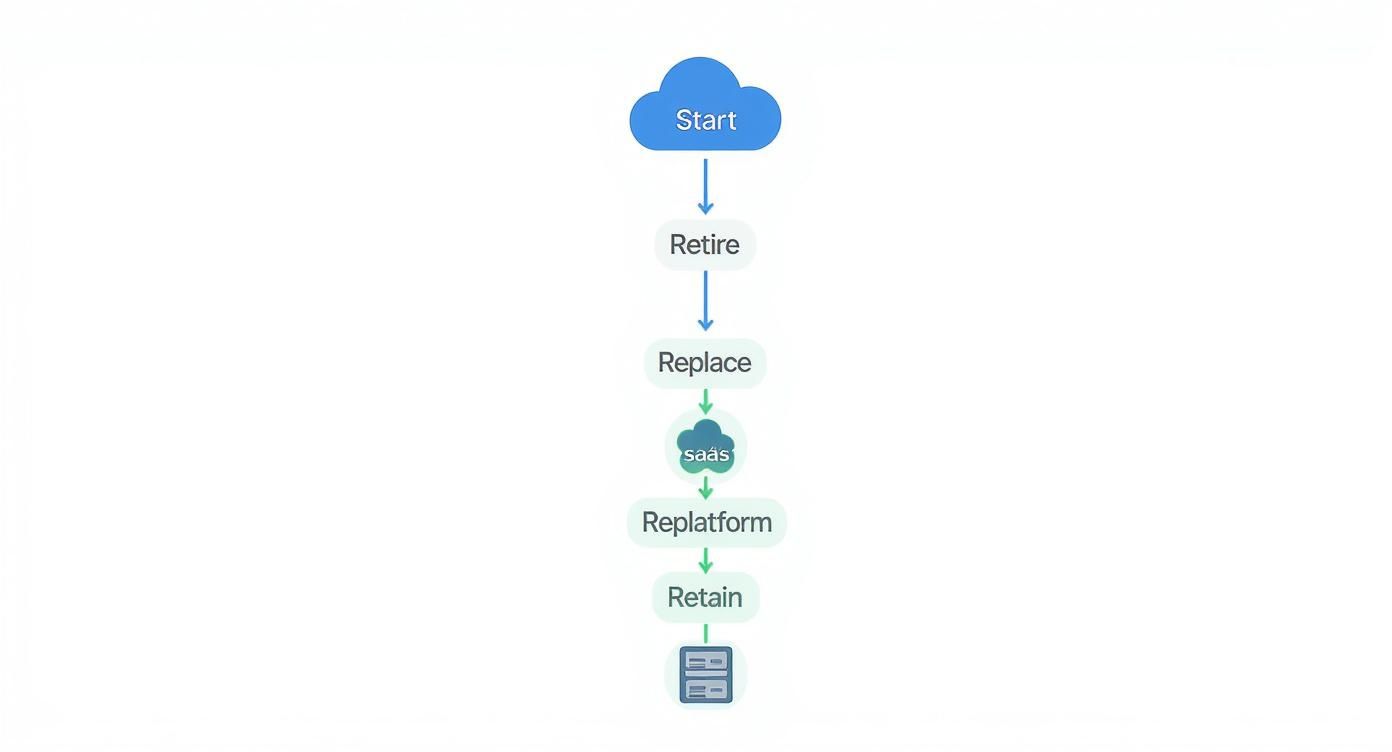
Each application needs a clear path forward, and that’s a decision that ultimately requires human judgment and oversight.
Ensuring Ongoing Alignment With Business-Value Scoring
A successful cloud migration strategy is not a “set it and forget it” plan. A formal business-value scoring process, reviewed quarterly with stakeholders from technology and business, ensures the migration continuously delivers on its original promises.
As your business evolves, this ongoing validation ensures your cloud environment remains a powerful asset, not just another expense. The global cloud migration market is exploding, largely because companies need the power to run advanced AI workloads. You can explore more about how cloud is becoming an inflection point for enterprise strategy to see how this shift is reshaping industries.
Implementing a Multi-Cloud and Hybrid-First Approach
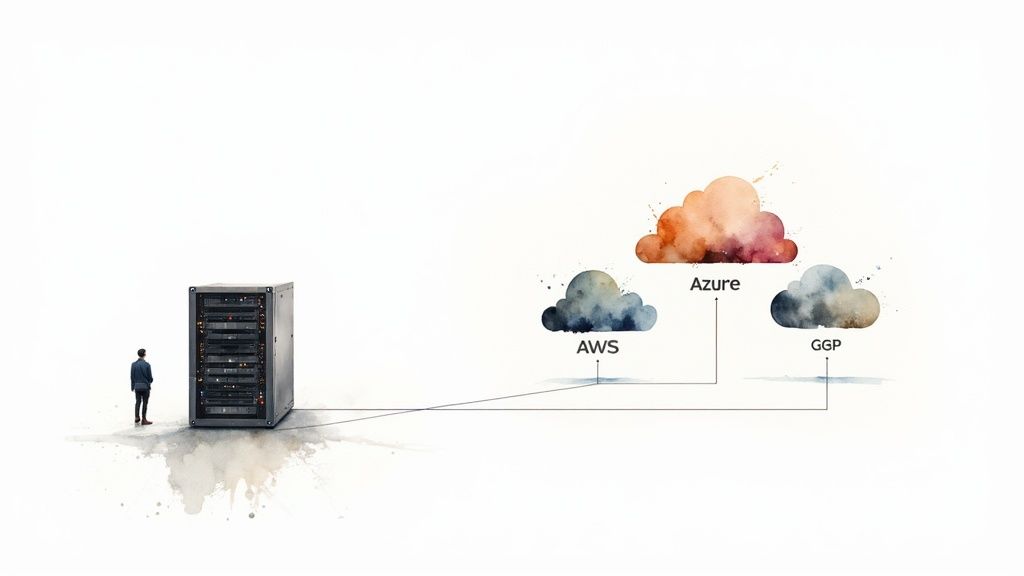
The era of single-vendor allegiance is over. Today, a smart cloud migration strategy is multi-cloud or hybrid by default. With 92% of enterprises adopting this approach, it’s the standard for building resilient, cost-effective systems.
Single-vendor lock-in killed an estimated 40% of 2025 pilot projects. Going multi-cloud means deliberately choosing the best services from different providers like AWS, Azure, and GCP. A hybrid setup keeps some workloads on-premises for compliance or latency reasons. This diversification is your best defense against vendor lock-in and gives you the power to control costs through repatriation—pulling workloads back in-house if cloud expenses spike.
Building a Cloud-Agnostic Foundation
The secret to a successful multi-cloud strategy is a consistent operational layer. The goal is to build once and deploy anywhere. This is where Infrastructure as Code (IaC) is essential.
Action: Standardize with Terraform and Federate with Trino. Use Terraform for IaC across AWS/Azure/GCP to create a unified deployment process. For data, use Trino for federated queries across disparate sources. This combination allows you to prototype multi-cloud applications in as little as two weeks and future-proofs you against the $405B in Big Tech CapEx volatility.
This approach gives you a powerful, vendor-agnostic base. You can move workloads between clouds with minimal friction, taking advantage of better pricing or new features as they emerge.
Monitoring and Governance Across Clouds
When your systems are distributed, you need a single pane of glass for visibility. Managing costs, security, and performance with native tools from each provider is a recipe for disaster.
- Continuous Asset Monitoring: Use a tool like CloudQuery to continuously scan all cloud accounts and monitor for “asset drift”—where live infrastructure no longer matches your Terraform code.
- Unified Data Access: A tool like Trino allows data teams to query data in Amazon S3, Azure Blob Storage, and Google Cloud Storage as if it were all in one database, avoiding costly data movement.
By pairing a standardized IaC foundation with unified monitoring, your cloud strategy becomes both flexible and resilient, giving you the freedom to choose the best services without sacrificing control.
Phased Pilots Over Big Bang: Start Small to Win Big
The “big bang” migration is dead. The 2025’s $912B market surge exposed its risks, with downtime rates exceeding 5%. A phased approach, starting with non-critical workloads, is the proven path to success, enabling 3x faster team ramp-up and minimizing disruption.
The smart move is to build momentum and institutional knowledge before tackling high-stakes systems.
Action: Select 2-3 Low-Risk Apps for Your First Pilot. Start with the non-critical 20% of your portfolio. Use a strategic value matrix to select 2-3 apps (e.g., internal tools) and execute the migration with tools like Azure Migrate or Google BigQuery Services for less than 1% disruption. Backfill learnings from this pilot into a centralized playbook to build muscle for core revenue systems.
This iterative approach de-risks the entire program, turning a daunting project into a series of manageable wins.
Embed FinOps from Day Zero to Control Costs

Uncontrolled costs sank an estimated 60% of migrations, turning strategic wins into financial nightmares. The most successful cloud migration strategies embed financial governance (FinOps) from day zero, not as an afterthought.
Action: Cap Migration Spend at 15% of Savings. For any workload, the total cost to migrate it must not exceed 15% of the savings you expect to realize in the first year. This hard rule forces financial justification for every decision and kills expensive “science projects” that deliver zero business value.
This discipline ensures every dollar spent on migration directly boosts the bottom line.
Building FinOps into Your Migration Engine
You can’t control what you can’t see. Real FinOps hinges on automation and total visibility. Integrate billing telemetry into the same lakehouse as your application metrics for a single source of truth.
- Automate Tagging: Use GitHub Actions to automatically tag every resource with its business unit, project, and owner. This is the foundation of accountability.
- Set Up Variance Alerts: Configure Prometheus to auto-alert on any spending variance greater than 10% from its forecast, catching overruns in hours, not weeks.
- Model Future Spend: When planning, model Year-1 spend at 2x the expected volume. This stress test uncovers hidden cost cliffs and gives you leverage when negotiating for free egress with vendors. This unlocks $147M ARR-scale efficiencies long-term.
For a deeper dive, our guide on what is cloud cost optimization offers more strategies for keeping costs down.
Security & Compliance as Migration Gates, Not Afterthoughts
Security can’t be bolted on at the end. With GDPR 2.0 and AI ethics audits, an estimated 25% of migration plans are rejected for failing to build in a zero-trust architecture from the start. Security must be a mandatory gate at every stage.
This requires a shift from the old castle-and-moat approach. In a zero-trust world, you assume every workload is potentially hostile.
Action: Mandate mTLS, Workload Identity, and Data SLAs. Enforce mutual TLS (mTLS) and workload identity with frameworks like SPIFFE/SPIRE in all replatforming. Use tools like Soda to define data SLAs as code. Run joint tabletop exercises with CISOs quarterly to wargame potential threats. This builds resilience to 2026’s quantum threats via pluggable crypto.
By building these non-negotiable security gates into your migration, you create an environment that is resilient by design.
People-First: Upskill 80% of Teams Pre-Move
A brilliant strategy is worthless without the people to execute it. Talent gaps delay 70% of projects, and with a persistent cloud engineer shortage for $90k–$200k roles, you can’t hire your way out. The only winning move is to build expertise from within.
Action: Mandate 6-Week Focused Bootcamps. Before the migration begins, enroll at least 80% of your technical teams in six-week bootcamps centered on cloud-agnostic tools: Terraform for IaC and the Loki/Grafana stack for monitoring. Pair this with shadow migrations for hands-on practice. This fosters internal experts, slashing consultant fees by 40% indefinitely.
Investing in your people builds a sustainable internal practice that pays dividends long after the migration is complete.
Measure Success by Post-Migration Velocity, Not Completion
A migration isn’t “done” when the last server is moved. 85% of “completed” migrations stall without optimization loops. True success is measured by post-migration velocity—improvements in deployment frequency and Mean Time to Recovery (MTTR).
Action: Wire dbt Models to SLO Dashboards. Track key Service Level Objectives (SLOs) like 99.99% uptime on real-time dashboards. Use this data to trigger auto-remediation via CrewAI agents. Conduct quarterly “kill-list” reviews to sunset assets with less than 10% utilization. This drives a 3x innovation speed into 2026.
Exit Ramps Baked In: 30-Day Portability or Walk
Vendor deprecations and lock-in burned companies for millions in 2025. Your migration strategy must include a clear exit plan from day one. Agility is your ultimate defense.
Action: Enforce Parquet/Avro Exports and Daily Portability Tests. Contract for open formats from kickoff. Mandate Parquet/Avro exports in your Master Service Agreements (MSAs) with daily portability tests and include $250k penalties for delays. Prototype repatriation paths early to ensure agility as DePIN and edge compute disrupt hyperscalers.
Frequently Asked Questions
When you’re staring down the barrel of a cloud migration, a lot of questions come up. Let’s tackle some of the most common ones with straightforward, practical answers to help you navigate the process and avoid the usual pitfalls.
What Is the First Step in Any Cloud Migration Strategy?
Before a single line of code is written or a server is provisioned, you need to get one thing: a signed, one-page document from your CEO or CFO. Seriously.
This isn’t about red tape. It’s about alignment. That document must define the specific business outcome you’re aiming for in the next 12 to 24 months. Without a clear P&L or growth target attached, your project will lack the high-level backing it needs to succeed when things get tough.
How Has the 7Rs Framework Evolved?
The old “7 Rs” model has become a bit clunky for today’s needs. The modern, more agile approach for 2025 is the 5R Framework. It’s designed to force faster, more decisive action by simplifying your choices.
Here’s the breakdown:
- Retire: Get rid of what you don’t need. Aim to decommission 30–40% of your application portfolio and cut the dead weight.
- Replace: Don’t reinvent the wheel. Swap out standard business functions with modern SaaS solutions.
- Replatform: Look for quick wins by moving applications to containers or managed services.
- Refactor: Reserve your heavy engineering effort for what matters most—re-architecting critical systems for AI-native or event-driven capabilities.
- Retain: Be strategic. Keep some workloads on-premises if there’s a solid compliance or technical reason to do so.
This updated framework cuts through the analysis paralysis and pushes you toward value-driven decisions for every single workload.
Should I Start with a Big Bang or a Phased Migration?
Always, always go with a phased pilot approach. A big-bang migration is just asking for trouble. The data shows downtime rates can jump over 5% when you try to move everything at once—a risk that’s simply not worth taking.
The smart move is to start small. Pick a non-critical 20% of your application portfolio, like internal tools or systems with low business impact. This gives your team a safe space to learn, build confidence, and iron out the kinks in your migration process. The lessons you learn here will be invaluable when it’s time to move your core, revenue-generating applications.
How Do I Prevent Cloud Migration Costs from Spiraling?
You have to build in FinOps from day zero. This isn’t an afterthought; it’s a core discipline. Uncontrolled spending is the number one reason why a staggering 60% of cloud migrations don’t deliver their expected ROI.
A solid rule of thumb is to cap your total migration spend at 15% of the savings you expect to see in the first year.
But a rule isn’t enough—you need to enforce it with automation. Mandate that every single cloud resource is tagged by business unit through your CI/CD pipelines. Then, set up automated alerts that trigger anytime spending deviates more than 10% from your forecast. This turns financial governance from a reactive, backward-looking report into a proactive, automated system that guards your budget.
Finding the right partner to guide you through this journey is just as important as the strategy itself. The CloudConsultingFirms.com 2025 guide offers an independent, data-driven look at the top cloud consulting firms. With over 2,400 verified client reviews and in-depth profiles, it’s a great resource for finding a partner that truly fits your budget, timeline, and goals. https://cloudconsultingfirms.com