What Is Cloud Native Architecture? An Actionable Guide for 2026+
Cloud-native architecture isn’t about a checklist of tools; it’s the deliberate design of systems that deliver a continuous competitive advantage through speed, safety, scale, and cost control. Think of it less as a technical blueprint and more as a business capability that fuels rapid, reliable innovation.
Defining Cloud Native as a Business Capability
Let’s cut through the noise. What is cloud-native architecture, really? True cloud-native architecture is a strategic approach to designing systems that create a lasting competitive edge. It’s not about adopting microservices and containers—by 2026, those are the minimum table stakes, not the end goal.
The real objective is to deliver features with incredible speed, operate with unwavering safety, and scale effortlessly on demand while controlling costs. The Cloud Native Computing Foundation (CNCF) provides the technical foundation—microservices, containers, CI/CD, and declarative APIs—but this is just the starting line.
A successful cloud-native strategy is measured by business outcomes: how quickly you can respond to market changes, how resilient your services are, and how efficiently you control costs as you grow.
To make this tangible, benchmark your organization against the “Cloud Native Maturity Model” (CNCF 2024). The target should be Level 4+ (automated, self-healing, policy-driven) within 18 months. Achieving this level is what separates market leaders from laggards, enabling you to innovate faster and more reliably than your competition.
From Technical Tools to Strategic Advantage
Understanding the difference between a technology-first view and a business-outcome approach is everything. This mindset shift is what truly drives a successful transformation, no matter which tools or cloud providers you end up choosing.
The following table breaks down this critical shift from the ‘what’ to the ‘why’.
| Traditional View (The ‘What’) | Strategic View (The ‘Why’) |
|---|---|
| “We need to use microservices." | "We need to ship features independently to get them to market faster." |
| "We must adopt containers and Kubernetes." | "We need a reliable, scalable platform to ensure our services are always available." |
| "Let’s build a CI/CD pipeline." | "We need to reduce the risk of human error and deploy changes with confidence." |
| "We need to move our workloads to AWS/Azure/GCP." | "We need to control infrastructure costs and pay only for what we use as we grow.” |
This strategic alignment ensures your technology choices serve the business, not the other way around. When you compare cloud service providers, this perspective helps you evaluate how their specific offerings map to your actual business goals. Ultimately, aligning your tools to your strategy is what empowers your teams to build products that win.
The Five Pillars of a Resilient Cloud Native Foundation
To get cloud-native right, you must move beyond the tools and think like an architect. Sure, technologies like Kubernetes are part of the equation, but they’re just building blocks. A truly resilient foundation is built on five core pillars that hardwire speed, safety, and scale into your system’s DNA.
Getting this wrong is the primary reason so many cloud transformations stall and fail to deliver on their promise. It’s a strategic shift, not just a technical one.
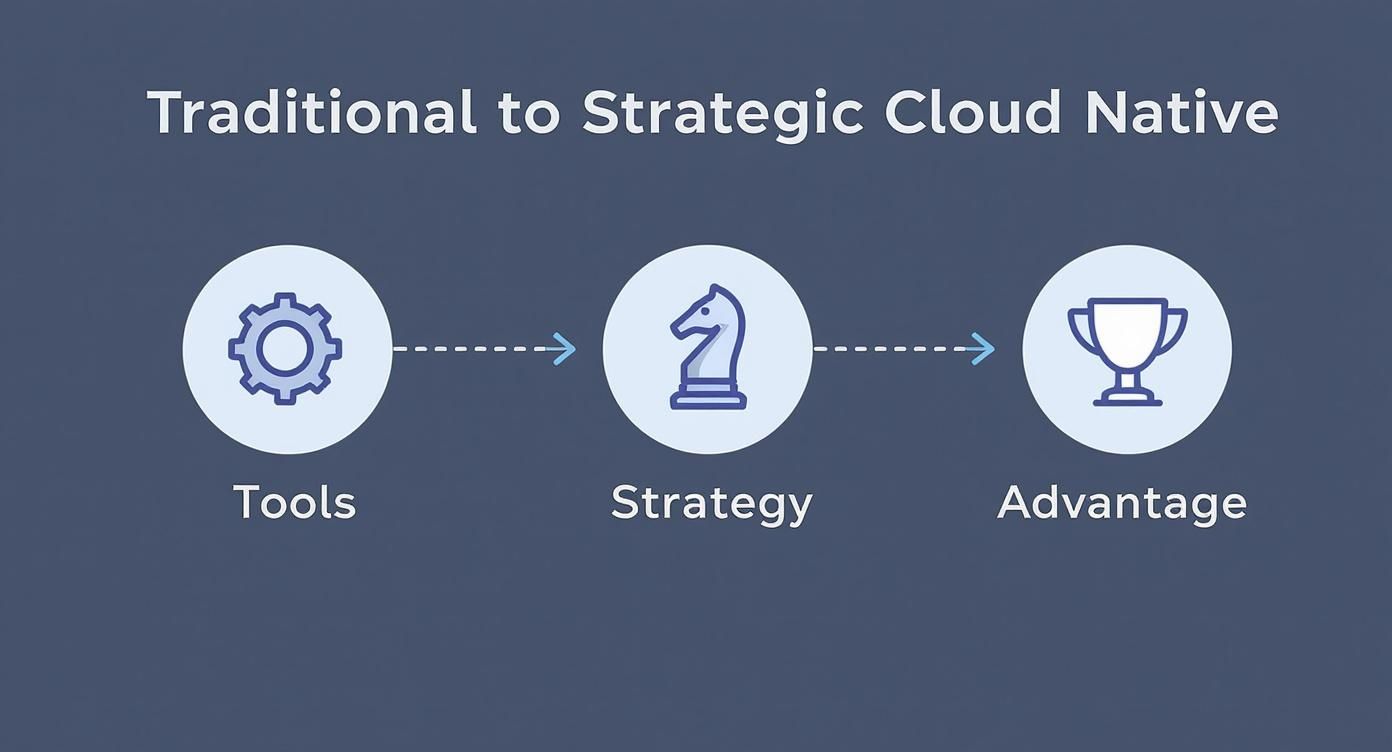
The path is clear: stop treating cloud native like a technology checklist and start treating it like a strategy. That’s the only way you unlock a real competitive advantage.
1. Microservices Are a Means, Not the End—Enforce Bounded Contexts Ruthlessly
The single greatest threat to a cloud-native initiative is the “distributed monolith.” It looks like microservices but is secretly a tangled mess of dependencies. You get all the operational complexity of distributed systems with the rigid coupling of a legacy application—the worst of both worlds.
2025 LinkedIn war stories show 70% of failed transformations come from building these distributed monoliths.
To avoid this disaster, use Domain-Driven Design (DDD) to draw real business boundaries. Each microservice must own a distinct business capability and communicate only through well-defined APIs. Mandate fitness functions in your Fitness Function-driven development (via tools like ArchUnit or custom scripts) that enforce architectural rules in your CI pipeline. For instance:
- Fail the build if a service exceeds 15 external synchronous calls.
- Fail the build if a service couples to another domain’s database.
These automated guardrails make good architecture non-negotiable.
2. Make Immutability the Default Deployment Artifact
Zero-downtime is non-negotiable. By 2026+, you must ban SSH into production nodes. The guiding principle is immutability: you never change a running system; you replace it.
This means baking golden AMIs or OCI images with tools like HashiCorp Packer and scanning them with Trivy before deployment. Enforce GitOps with tools like ArgoCD or Flux so the cluster state is the single source of truth, perfectly mirroring your Git repository. The real-world payoff is staggering: Mean Time To Recovery (MTTR) drops from days to <8 minutes, a trend observed in Fortune-100 migrations between 2024-2025.
3. Design for Observability at the Architecture Level, Not as an Afterthought
Observability isn’t a feature you add later; it’s an architectural requirement from day zero. Distributed systems without it are opaque black boxes. 2025 Reddit threads confirm teams that skip this pay 3–5× in incident toil later.
Instrument OpenTelemetry from day zero with auto-instrumentation for Java, .NET, Python, and Go. Ship all telemetry to a single backend (e.g., Honeycomb or Grafana Alloy) for a unified view.
Require every new service to emit the three “golden signals” (latency, traffic, errors) plus specific business KPIs (e.g., “orders processed,” “user sign-ups”) from its inception.
This approach transforms observability from a reactive troubleshooting tool into a proactive engine for understanding system and business performance.
4. Shift Resilience Left with Contract Testing & Chaos Engineering in CI
True resilience means expecting failure and building systems that handle it gracefully. This requires shifting resilience testing “left” into your CI/CD pipeline.
Two practices are mandatory:
- Consumer-Driven Contract Testing: Use Pact or Spring Cloud Contract to verify service interactions without full end-to-end environments, catching breaking API changes early.
- Chaos Engineering in CI: Run Gremlin or Chaos Mesh attacks on every pull request targeting production. This forces code to be resilient to real-world turbulence from the start.
According to 2025 State of DevOps reports, companies doing this weekly achieve 99.99%+ availability and deploy 50× more often than their peers.
5. Treat Infrastructure as Code as Application Code
Your infrastructure code deserves the same rigor as your application code. Store Terraform, Open Policy Agent (OPA), or Pulumi code in the same monorepo as the services it supports. Enforce peer review and static analysis with tools like tfsec and Checkov.
Top-tier organizations in 2025 run “policy-as-code” gates that automatically block non-compliant infrastructure changes. This cuts audit time by 90% and prevents 2024-style CrowdStrike-scale outages.
Platform Engineering Is the Real Cloud-Native Multiplier
The principles of cloud-native architecture are powerful but introduce significant complexity. Expecting every development team to master Kubernetes, Istio, and observability tooling is a fast track to burnout and failure.
This is why platform engineering has become the single most critical investment for succeeding with cloud-native.
A dedicated platform team’s mission is to reduce the cognitive load on developers by building and maintaining an Internal Developer Platform (IDP). This centralized, self-service layer abstracts away infrastructure complexity, providing developers with “golden paths”—standardized, pre-approved ways to provision resources and deploy code.

From Friction to Flow with an Internal Developer Platform
A well-designed IDP, often built with tools like Backstage for the portal and Crossplane for infrastructure abstraction, is a game-changer. Instead of waiting weeks for a ticket to be resolved, a developer can self-provision a production-ready environment in <10 minutes.
This isn’t a convenience; it’s a strategic advantage. It frees developers to solve customer problems instead of wrestling with YAML. The result is a massive 3–5× boost in developer productivity and deployment frequency.
The Strategic Imperative of Platform Teams
The global developer community has embraced this shift. In 2025, an estimated 15.6 million developers are using cloud-native tools, as detailed in the state of cloud native computing in 2025. Platform engineering is essential for managing this adoption securely and efficiently.
Without an IDP, you get chaos: duplicated effort, inconsistent tooling, security holes, and a support nightmare. This is why so many cloud-native transformations fail.
Gartner’s 2025 predictions are stark: 80% of enterprises failing cloud-native by 2027 will cite the lack of platform teams as a primary reason. Invest here first.
Winning organizations treat platform engineering as a growth engine, not a cost center. It is the ultimate force multiplier for your entire engineering organization.
Key Cloud-Native Strategies for 2026+
Understanding the principles is one thing; executing them is another. Two key strategies will define your success, directly impacting your speed, risk, and bottom line.
Global spending on public cloud services is projected to hit $723.4 billion in 2025, a 21.5% increase from 2024. With over 75% of companies now using serverless platforms, the strategic direction is clear. You can explore more data in recent cloud computing statistics from CloudZero.
Serverless First for New Event-Driven Workloads
For new event-driven workloads, your default choice should be serverless.
Platforms like AWS Lambda, Azure Functions, and Google Cloud Run offload nearly all infrastructure management, freeing engineers to focus on business logic. This is ideal for spiky or unpredictable workloads, especially those under 10,000 requests per second (RPS).
Serverless isn’t a silver bullet. If your application needs <500ms cold starts or requires a custom runtime, dropping to containers is the right move. However, making serverless the default forces a conscious decision to take on the operational overhead of containers. Real 2025 data shows that serverless-first strategies reduce compute bills by 40-60% versus “lift-and-shift” Kubernetes for typical enterprise workloads. This is a cornerstone of any effective cloud migration strategy.
Progressive Delivery Is Mandatory for Risk Reduction
The “big bang” release is dead. Deployments must be so safe they become non-events. The key is progressive delivery, which should be a mandatory requirement for every production rollout.
Two core practices are essential:
- Feature Flags: On/off switches for your code that let you deploy functionality to production while keeping it “dark.” This decouples deploying code from releasing it to users, enabling safe testing with internal teams or small customer cohorts.
- Canary Releases: Instead of a full rollout, you route a small fraction of traffic (e.g., 1%) to the new version. Automated tools like Flagger, integrated with a service mesh like Istio or Linkerd, monitor key metrics. If errors or latency spike, the rollout is automatically reversed before most users are impacted.
Companies that adopted this in 2024-2025 reduced customer-impacting incidents by 75% and increased deployment frequency from monthly to multiple times per day.
When deployments are safe, teams lose their fear of shipping code. Your delivery pipeline transforms from a source of stress into a genuine competitive advantage.
Integrating Cost and Carbon as Architectural Drivers

For years, cloud-native architecture was defined by speed, resilience, and scale. That’s no longer enough. By 2026, excellence demands two more dimensions: financial efficiency and environmental responsibility.
Cost and carbon are now first-class architectural concerns, not downstream problems for finance. This means embedding FinOps and sustainability gates into your definition of done, turning them into guardrails that guide engineering decisions from day one.
Making Financial and Environmental Costs Visible
You can’t optimize what you can’t see. The critical first step is to give developers immediate, actionable feedback on the impact of their work directly in the CI/CD pipeline.
- Cost Analysis in Pull Requests: Tools like Infracost scan infrastructure-as-code changes and post a comment in the pull request showing the estimated monthly cost impact.
- Carbon Footprint Tracking: Similarly, tools like Cloud Carbon Footprint estimate the CO2 emissions of cloud resources, enabling teams to make smarter choices about regions and instance types.
This transparency empowers engineers to weigh the performance benefits of a larger instance against its direct impact on the P&L—and the planet.
Treating cost as an architectural constraint doesn’t stifle innovation; it focuses it. This practice forces teams to build more efficient, elegant, and ultimately more profitable systems.
Tying Engineering OKRs to Business Outcomes
To make this cultural shift stick, align incentives. Leading enterprises in 2025 are tying 15-20% of engineering OKRs directly to efficiency and sustainability goals, such as:
- Reducing the unit-cost per transaction.
- Lowering CO2e (carbon dioxide equivalent) per active user.
- Improving the cost-to-serve ratio for a specific service.
This powerful alignment elevates your cloud-native architecture from a pure speed play into a board-level margin driver, turning efficiency into everyone’s job. Explore proven cloud cost optimization strategies to put these financial guardrails into practice.
Your Cloud-Native Readiness Checklist
Making the move to a truly cloud-native architecture is a strategic journey, not just a technical flip of a switch. Before you even think about containers and service meshes, you need to take a hard look at where your organization stands today. This isn’t about the tools you have; it’s about the culture, processes, and business alignment that will ultimately determine your success.
Use these questions to get an honest assessment of your starting point. They’ll help you spot the gaps and build a roadmap that’s grounded in reality.
Organizational and Cultural Readiness
Let’s start with your people and how they work. A successful cloud-native shift depends on breaking down old silos and giving teams the power to own their software from the first line of code to the final production deployment.
- Platform Engineering Mandate: Do you have a dedicated platform engineering team, or at least a plan to build one? You can’t expect every developer to become a Kubernetes expert overnight—that’s a surefire way to stall progress.
- Team Autonomy: How are your teams structured? Are they organized by business capabilities (like payments or inventory) with full ownership, or are they stuck in functional silos (frontend, backend, QA, ops)? The latter is a major roadblock.
- Psychological Safety: What happens when something breaks? If your culture defaults to blame, you’ll never improve. True resilience comes from embracing blameless postmortems and learning from failure, not punishing the people involved.
Process and Technical Maturity
Next, it’s time to examine your technical habits. Modern cloud-native operations are built on a foundation of automation and discipline. You have to treat every part of your system with the same rigor you apply to your application code.
- Infrastructure as Code (IaC): Is your infrastructure defined in code using tools like Terraform or Pulumi? More importantly, is that code stored in version control and subject to the same peer review and testing as your application? If not, it’s just a collection of scripts.
- Observability by Default: Do your teams build instrumentation for metrics, logs, and traces into new services from day one? Or is observability a reactive scramble that only happens after an outage? It needs to be part of the definition of “done.”
- Automated Resilience Testing: Are you actively trying to break things in a controlled way? This means running chaos engineering experiments or contract testing as a standard part of your CI/CD pipeline. Proving your system can withstand failure should be a routine check, not a rare, heroic event.
A lot of teams get fixated on deployment frequency. But the metric that really matters is your change failure rate. Shipping code multiple times a day is useless if half of those deployments cause problems—that’s just creating chaos faster.
Business and Strategic Alignment
Finally, none of this matters if your technical goals aren’t directly connected to business results. A cloud-native architecture must serve the business, making it more efficient, competitive, and responsible.
- Cost as a Design Constraint: Do your architectural reviews actually talk about money? Your engineers need to understand the financial impact of their infrastructure choices before they hit deploy, not after the bill arrives.
- Sustainability Metrics: Have you started thinking about the carbon footprint of your cloud workloads? By 2026, responsible architecture absolutely includes environmental efficiency.
- Value-Driven Goals: Are your engineering objectives tied to real business KPIs, like reducing the cost per transaction or accelerating time-to-market? Or are you chasing vanity metrics like “number of microservices deployed”?
Cloud Native Maturity Self-Assessment
To help you pinpoint where you are on this journey, we’ve put together a simple self-assessment table. It’s designed to give you a quick snapshot of your maturity across key areas, from your initial starting point to a more strategic, advanced state. Be honest about where you stand—it’s the first step toward figuring out where you need to go next.
| Dimension | Level 1 (Starting) | Level 4+ (Strategic) |
|---|---|---|
| Culture & Teams | Functional silos (dev, ops, QA). Blame-focused incident response. | Autonomous, domain-oriented teams with end-to-end ownership. Blameless postmortems are standard practice. |
| Architecture | Monolithic application with tightly coupled components. Manual scaling. | Composable architecture of independent services. Dynamic scaling and self-healing are built-in. |
| CI/CD & Automation | Manual or semi-automated deployment processes. Infrequent, large releases. | Fully automated, progressive delivery pipelines. Multiple, small, independent deployments per day. |
| Infrastructure | Manually provisioned servers or basic virtualization. Configuration drift is common. | Infrastructure is immutable, provisioned entirely via declarative code (IaC). All changes are versioned and tested. |
| Observability | Basic monitoring and logging, often reactive. Siloed data across tools. | Proactive, unified observability with metrics, logs, and traces correlated by default for every service. |
| Security | Security is a separate, late-stage review gate. Manual compliance checks. | Security is integrated into the entire lifecycle (“DevSecOps”). Automated policy enforcement and continuous scanning. |
| Business Alignment | IT is seen as a cost center. Technical metrics are disconnected from business outcomes. | Technology is a core business driver. Engineering goals are directly tied to business KPIs like revenue and efficiency. |
This table isn’t a scorecard; it’s a compass. Use it to identify your biggest opportunities for improvement and to start a conversation with your teams about the concrete steps needed to advance your cloud-native strategy.
Your Cloud-Native Questions Answered
Even the best-laid plans run into practical questions on the ground. When you start talking about moving to a cloud-native model, some very common and very fair questions always seem to pop up. Let’s tackle them head-on to clear up the confusion and help you avoid some of the most common traps.
”Isn’t ‘Cloud Native’ Just a Fancy Term for Microservices and Kubernetes?”
Not at all, and this is probably the most common misconception out there. Think of it this way: Kubernetes and microservices are incredibly powerful tools, like a high-end hammer and saw. But just owning the tools doesn’t make you a master carpenter.
Cloud native is the architectural blueprint—the strategy. It’s about designing systems specifically to thrive in the cloud, focusing on business goals like shipping features faster, bouncing back from failures instantly, and running operations smoothly. The tools are just how you bring that blueprint to life.
Confusing the tools for the strategy is a classic mistake. It often leads to teams building incredibly complicated, expensive systems that don’t deliver any of the promised agility. The real goal is to make the business more competitive, not just to use the latest tech.
”How Do We Go Cloud Native Without a Massive, Risky Re-architecture?”
You don’t have to rewrite everything at once. In fact, you shouldn’t. That “big bang” approach is a recipe for disaster.
A much smarter way to start is to pick your battles. Either launch a brand-new project using cloud-native principles from day one or apply the “strangler fig” pattern to an existing part of your system. Find a single, high-value service within your legacy application that’s causing pain or holding you back and carefully carve it out. This gives you a contained experiment where you can learn, build skills, and show real business value quickly.
The single most important thing you can do first? Stand up a Platform Engineering team. Their job is to build the “paved road” for your developers, creating a solid, reusable foundation. This ensures your first steps are secure and scalable, setting the right example for everything that follows.
By baking in concepts like Infrastructure as Code and solid Observability from the very beginning of that pilot project, you create a working blueprint and build the momentum you’ll need for the bigger journey ahead.
”Is This All Too Complex for Our Small Team?”
It definitely doesn’t have to be. For smaller teams, trying to copy the massive toolchains of a company like Netflix is a trap. The secret is to let the cloud provider do the heavy lifting for you.
Adopting a “Serverless First” mindset can be a game-changer. Instead of worrying about managing servers, you focus purely on writing your business logic in functions (like AWS Lambda) and connecting them to other managed services. This lets a small team achieve massive scale and incredible resilience without needing a small army of operations engineers.
The key is to embrace the principles—like automation and observability—that fit your team’s size, rather than getting bogged down by complex tooling. This way, even a tiny team can punch well above its weight, getting all the benefits of cloud-native thinking without the operational headache.
Navigating the complexities of a cloud-native journey is much easier with the right guide. At CloudConsultingFirms.com, we provide data-driven comparisons and over 2,400 verified reviews to help you select the perfect AWS, Azure, or Google Cloud consultant for your specific needs. Start your search and find your ideal cloud partner today.